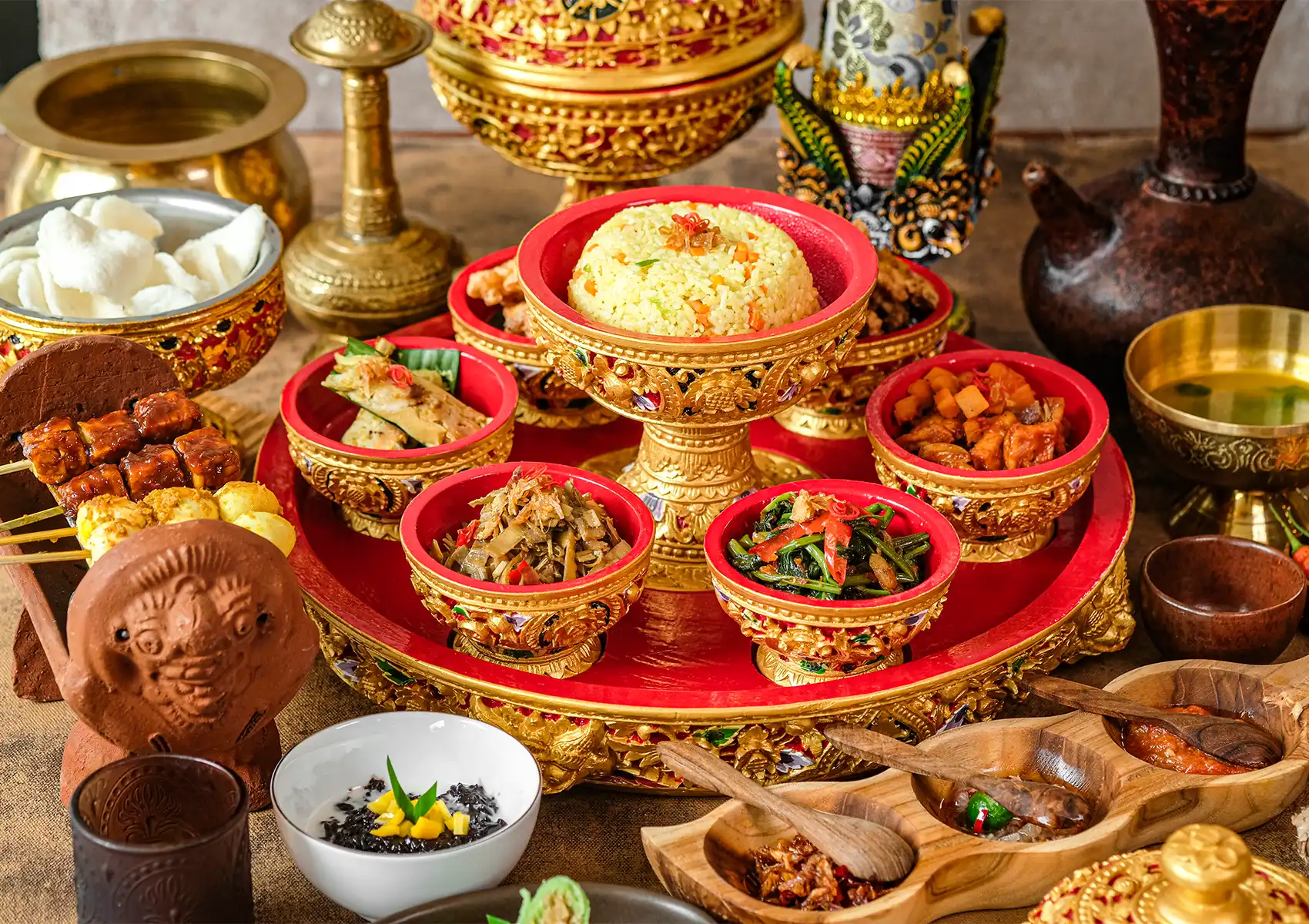
The Foundation of Balinese Flavours
Balinese cuisine is not simply food. It is a living archive of ritual, philosophy, and devotion, passed down through generations of families who understood that what you place on a table carries the weight of everything that came before it. At the heart of this culinary heritage lies an extraordinary reverence for process, for the knowledge that the way a dish is prepared is just as sacred as the ingredients themselves. Few places on earth have preserved that relationship between cook and craft quite as faithfully as Bali.
To understand traditional Balinese cooking, you must first understand the island’s spiritual framework. Balinese Hinduism infuses every element of daily life, and the kitchen is no exception. Food prepared for offerings, ceremonies, and family meals follows ancient guidelines that dictate not only what is used but how, when, and by whom it is prepared. The result is a cuisine of extraordinary depth, where every dish tells a story that stretches back centuries.
The Importance of the Base Gede Spice Paste
No conversation about authentic Balinese cooking is complete without discussing Base Gede, the grand spice paste that forms the foundation of countless traditional dishes. This extraordinary blend typically includes shallots, garlic, galangal, turmeric, ginger, lemongrass, candlenuts, lesser galangal, and a medley of aromatic chillies, all combined in proportions that vary from village to village and family to family.
What sets Base Gede apart from modern spice preparations is the way it is created. Traditional Balinese cooks insist on the batu uleg, the heavy volcanic stone mortar and pestle, to grind the ingredients by hand. This is not merely a matter of custom. The manual grinding process ruptures the cell walls of each ingredient in a fundamentally different way than a machine blade, releasing the essential oils and volatile aromatic compounds that give the paste its character. A blender chops; a stone mortar transforms. The result is a paste with a rougher, more integrated texture that carries layers of flavour no mechanical process can replicate.
When you taste Base Gede prepared the traditional way, you encounter something alive, complex, and deeply rooted in the land itself. The turmeric offers its golden warmth, the galangal its sharp, resinous bite, and the candlenuts their quiet, fatty richness, binding everything into a paste of remarkable harmony.
Ancient Techniques in a Modern Kitchen
The genius of Balinese culinary tradition lies not in its resistance to time, but in its ability to remain relevant across centuries. The techniques that defined the royal kitchens of Klungkung and the village hearths of Ubud have proven themselves not because they were preserved in amber, but because they are genuinely, irrefutably superior for the dishes they serve.
Slow Roasting and Wood Fire
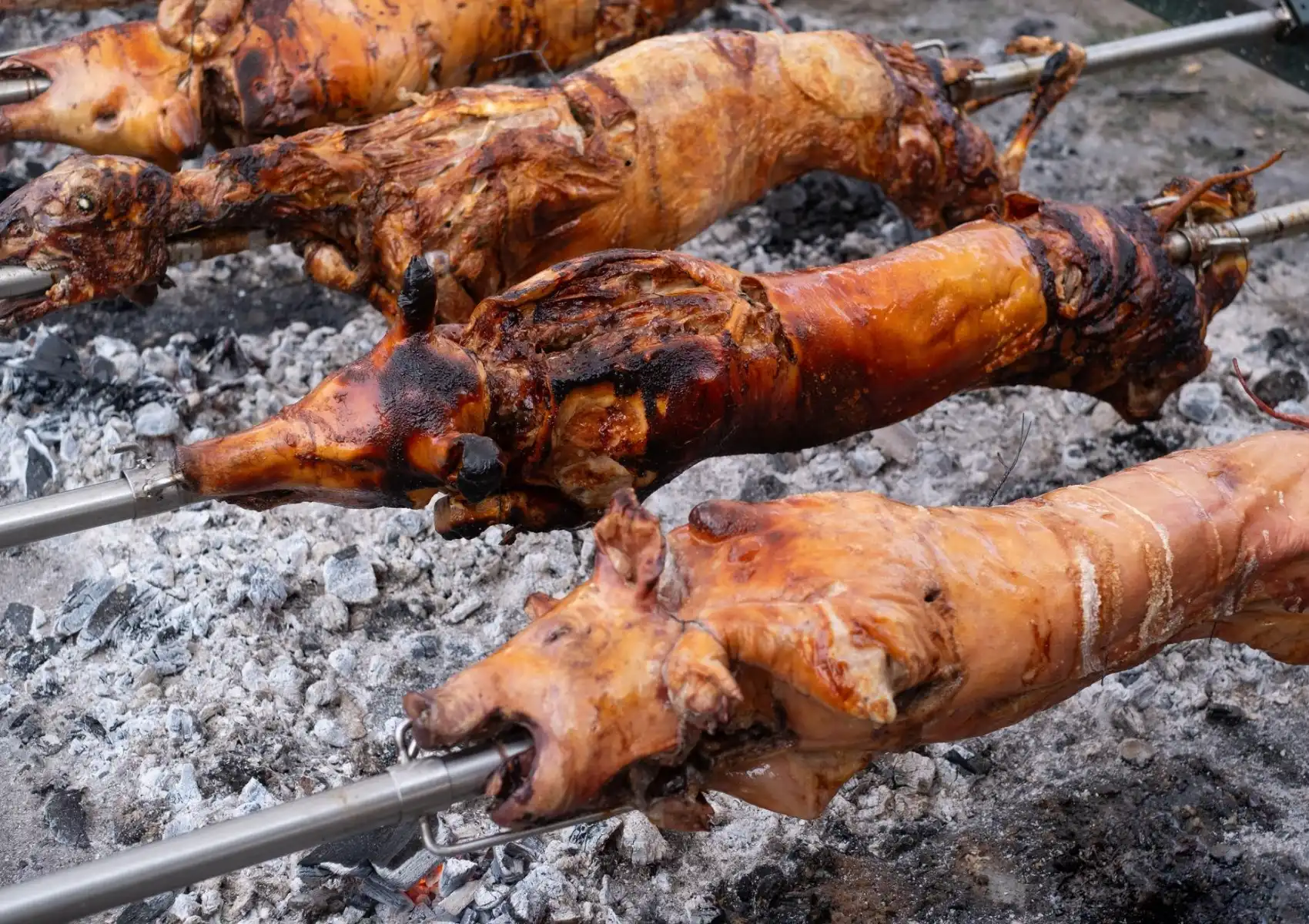
Few techniques in traditional Balinese cooking are as defining as the slow roast. The most celebrated example is Babi Guling, the iconic suckling pig preparation that has become synonymous with Balinese festivity. Yet behind the drama of the whole roasted pig lies a technique of extraordinary patience and precision.
The pig is stuffed with a mixture of Base Gede, lemongrass, and fragrant leaves, then mounted on a bamboo spit and slowly rotated over a wood fire for hours. The choice of wood matters enormously. Coconut wood and local hardwoods impart a subtle smokiness that infuses the flesh at a depth that gas or electric heat simply cannot achieve. The slow rotation ensures that the heat penetrates evenly, breaking down the collagen within the meat and rendering the fat in a gradual, controlled process that leaves the skin shatteringly crisp and the flesh yielding and moist.
This same philosophy of patient, low, consistent heat governs preparations like Bebek Betutu, the slow-cooked duck that may be wrapped and buried beneath hot coals for the better part of a day. The result is a depth of flavour that rewards the cook’s patience with every single bite, a tenderness that cannot be rushed or replicated by any shortcut. In Balinese cooking, time is itself an ingredient.
Steaming in Natural Wrappers
Alongside fire, steam has played an equally essential role in shaping the character of Balinese cuisine. But it is the vessel for that steam that makes the technique truly extraordinary. Banana leaves and young coconut fronds, known as janur, serve not merely as packaging but as active participants in the cooking process.
When food is wrapped tightly in banana leaves and placed over steam or nestled among hot embers, the leaves do several things simultaneously. It creates a sealed microenvironment that traps moisture, ensuring the food cooks in its own juices and the aromatics of the spice paste rather than losing flavour to the surrounding air. It also imparts its own subtle, grassy fragrance, a gentle vegetal perfume that becomes inseparable from the dish itself.
Pepes Ikan, the spiced fish preparation wrapped in a banana leaf and steamed, exemplifies this technique beautifully. The mahi mahi, marinated in Bumbu Bali, becomes suffused with its spice coating during cooking, in a way that open-pan methods cannot achieve. The leaf holds everything together, both physically and aromatically, producing a dish that is simultaneously intensely flavoured and remarkably delicate.
Experiencing Heritage at CasCades Bali

To understand traditional Balinese cooking in the abstract is one thing. To taste it, course by thoughtful course, in one of the most breathtaking settings in all of Ubud, is something else entirely. CasCades Bali’s Balinese Rijsttafel is precisely that: a curated journey through the full breadth of the island’s culinary heritage, presented with the elegance and intention that the tradition deserves.
The Rijsttafel, which translates literally as “rice table,” is a format that invites guests to experience a landscape of flavours rather than a single dish, and at CasCades it has been lovingly reinterpreted to showcase the finest techniques and ingredients of the island. Beginning with Rujak Bali, the refreshing interplay of tropical fruit and a palm-sugar dressing that awakens the palate, the meal moves through the maritime richness of Kuah Be Pasih, where green papaya, local scallops, and barramundi come together in a broth of extraordinary depth.
The following mains read as a masterclass in the very techniques described above. The Pepes Ikan arrives fragrant from its banana leaf cocoon. The Bebek Betutu yields with the quiet confidence of a dish that has had all the time it needed. Babi Guling offers that incomparable contrast of crackling skin and tender flesh, making it legendary across the island. Each preparation on the menu represents not merely a recipe but a technique, a story, and a lineage.
At IDR 1,500,000 per couple, the Balinese Rijsttafel at CasCades is more than a dining experience. It is the most comprehensive and beautifully considered introduction to authentic Balinese cooking that Ubud has to offer. Begin your culinary journey with us and let the island’s heritage unfold, one extraordinary course at a time.
Curating the Perfect Pairing
A meal of such complexity and nuance deserves a wine that can meet it with equal sophistication. The spice profiles that define traditional Balinese cooking, the aromatic heat of galangal, the citrus brightness of lemongrass, and the deep savouriness of slow-roasted meats, present a genuinely interesting challenge for the sommelier, and one that CasCades’ curated international wine collection is superbly equipped to meet.
For lighter preparations, particularly seafood courses and vegetable dishes such as Jukut with its bright combination of serombotan, lawar, and urap, a well-chosen Riesling offers a compelling companion. The grape’s natural acidity cuts through the richness of coconut-based preparations with elegant precision, while its floral aromatic character echoes the fragrant spice pastes without competing with them. An off-dry style from the Mosel or Alsace can also provide a gentle counterpoint to the heat of dishes prepared with the full complement of Balinese chillies.
For the richer meat preparations, a Sauvignon Blanc with sufficient textural weight, perhaps from Marlborough or the Loire Valley, brings a herbaceous quality that finds a natural kinship with the galangal and lemongrass present throughout the meal. Its freshness prevents the palate from being overwhelmed by successive waves of spice and slow-cooked intensity, serving as a gentle reset between courses.
At CasCades, our sommeliers are delighted to guide you through the wine list to find pairings that honour both the tradition of the kitchen and the pleasure of the glass. Discover the art of Balinese dining in its fullest expression. Reserve your table for an evening where ancient technique and contemporary elegance meet, and where every sip and every bite is a conversation between the old world and the new.